
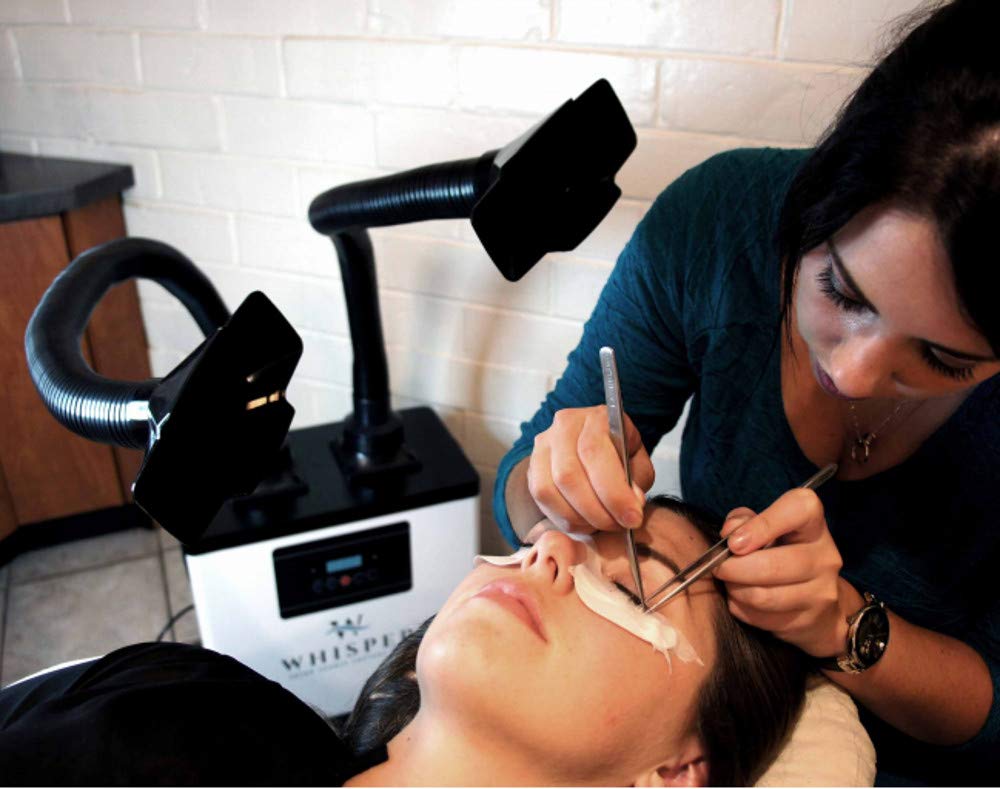
Today we’re going back to high school physics class. Anyone who skipped physics or just didn’t love it, this one’s especially for you. 😉
As we know, air humidity is one of the main factors in how lash adhesive behaves. And there are two kinds of humidity: relative and absolute.
The weight, or more precisely the mass, of water vapor contained in 1 cubic meter of air is called absolute humidity. In other words, it’s the density of water vapor in the air. At a given temperature, air can absorb a very specific amount of water vapor and reach full saturation. Absolute humidity at saturation is called the moisture capacity.
Moisture capacity rises sharply as temperature goes up. The ratio of absolute humidity at a given temperature to the moisture capacity at that same temperature is called relative humidity.
In other words:
At different room temperatures, the % humidity will be different, even though the actual amount of moisture in the air hasn’t changed.
This means it’s more accurate to think about ideal temperature-and-relative-humidity as a specific pairing, not as separate recommended ranges, because at a recommended 70°F versus 75°F the % humidity you need will vary, even while the amount of moisture in the air stays the same.
Dial in your room to the exact pairing your adhesive maker recommends, and use a thermo-hygrometer to keep both readings in check as you work.
You might also like
 Trending Effects: Anime, Kim, Kylie, Angel
 Working the Inner and Outer Corners
 Adaptive Lash Extensions: What They Really Are
 Working With the L Curl
 The Ombre Lash Technique and Shadow Effect
 “I Swear I Washed Them!” What to Do When Clients Ignore Aftercare
 Why You Can (and Should) Get Lash Extensions Wet
 Colored and Creative Lash Extensions
 Competition Lash Looks
 Summer Lashing: How to Tame Your Adhesive in the Heat
 The Mascara Effect in Lash Extensions
 LED Lash Extensions: The Method, Pros, and Cons
 Lash Porosity and How It Affects Retention
 Bottom Lash Extensions
 The Winged Eyeliner Lash Effect
 The Top 5 Trending Lash Effects (With Maps)
 Is Hypoallergenic Lash Adhesive a Marketing Myth?
 The Wet Look Lash Effect
 How to Match Colored Lashes to Eye Color
 Working With Lash Adhesive in Winter
 Room Microclimate: The Ideal Temperature and Humidity for Lashing
 How to Work With Baby Lashes (Anagen Stage)