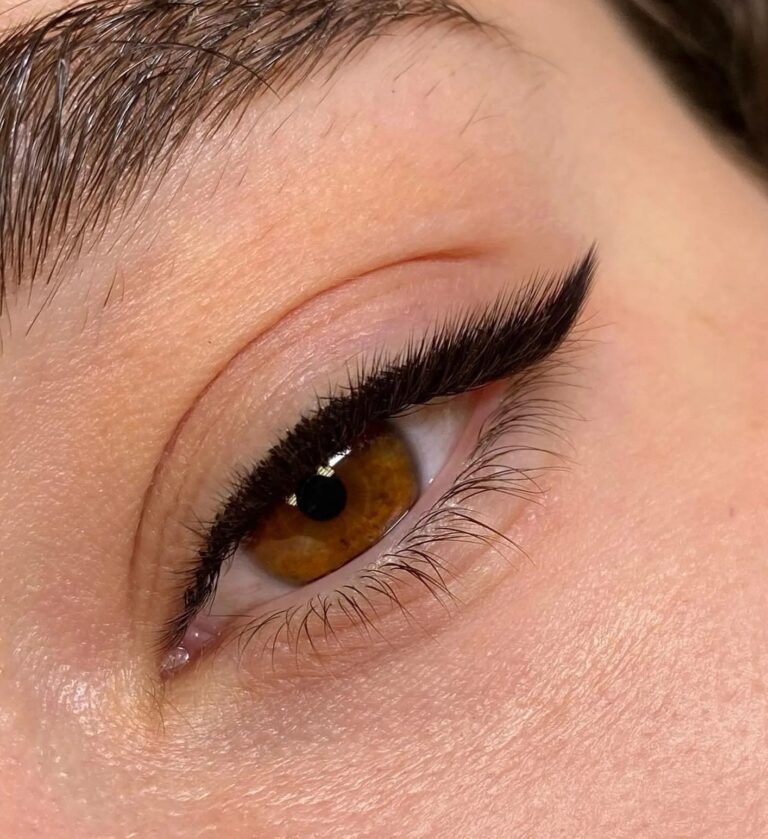
The modern lash industry doesn’t stand still: every year brings new techniques and materials. One of those newer arrivals is LED lash extensions, which has already won over artists and clients alike. Let’s break down what it is and what makes it different, and take an honest look at the pros and cons, including the parts the marketing usually leaves out.
What is the LED lash extension system?
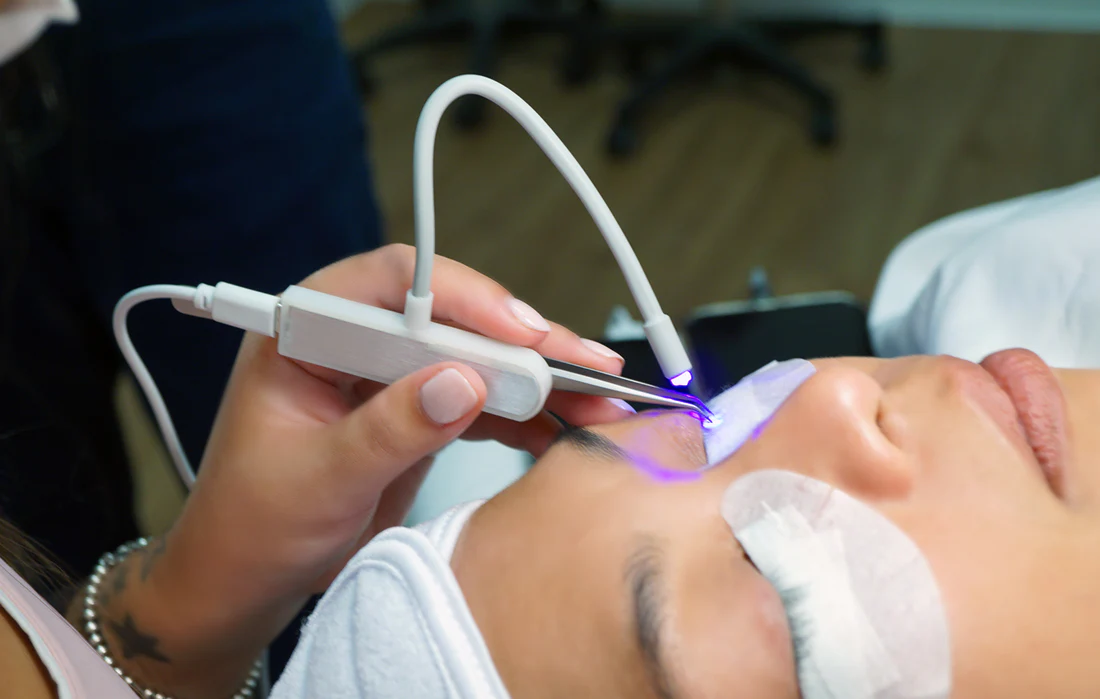
LED lash extensions are an innovative technique that uses a special adhesive activated by ultraviolet (UV) light. Instead of traditional adhesive that cures in the air, LED adhesive sets quickly and safely under an LED lamp. This lets the artist precisely control when the lashes fix in place, for faster, higher-quality work.
How the adhesive actually cures. Regular lash adhesive cures from humidity in the air and fully sets over 24 to 48 hours. LED adhesive is a gel with photoinitiators, components that react to light and trigger curing on command. It’s worth understanding that most LED adhesives are still cyanoacrylate-based, just with these light-sensitive additives.
One upside is fewer adhesive fumes. Regular adhesive can give off fumes that sometimes cause eye irritation, especially for sensitive clients. Because LED adhesive sets right away, it off-gasses far less, and the treatment feels more comfortable.
LED light: UV or not?
Partly yes, and this is where the marketing gets a little slippery. Many “LED” and “UV LED” lash lamps emit near-ultraviolet around 395 to 405 nm, right on the border of ultraviolet and visible light, at a low power of 5 to 10W. Meanwhile some manufacturers say their device already emits visible light, in the violet range above 400 nm, and that it’s “not UV.”
So you can’t flatly say “it’s UV” or “it’s not UV”: it depends on the specific device, and the word “LED” is partly a marketing term.
Is LED lashing safe for the eyes?
Done correctly, the treatment is considered safe, and here’s why: the lamp is low-powered (around 5 to 10W versus 60W for a nail lamp), and the light is directed locally and for only a few seconds per lash. The lamp gives off a barely noticeable warmth, and across the whole appointment it runs just a few minutes total. Some brands publish safety certifications for their devices (for example ANSI RP-27, low risk groups under IEC 62471) and state that goggles over closed eyelids aren’t needed.
An important caveat: there are no peer-reviewed studies on the long-term safety of LED lashing specifically, and experts don’t agree on eye protection. Eye-care specialists point out that eyelids don’t fully block UV, and recommend applying UV protection (sunscreen) or placing black patches over the upper lids.
Who invented and patented the LED method?
LED lash extension technology was developed and patented by Soo-Jin Yang of the US, who spent years refining lash techniques and bringing innovation to the industry. Her method, where the adhesive cures under a lamp, was a real breakthrough, and today the technology is patented in more than 25 countries.
But it’s no longer the only system. The method has since gained other implementations too, including some that position themselves openly as UV.

What does an LED lash appointment look like?
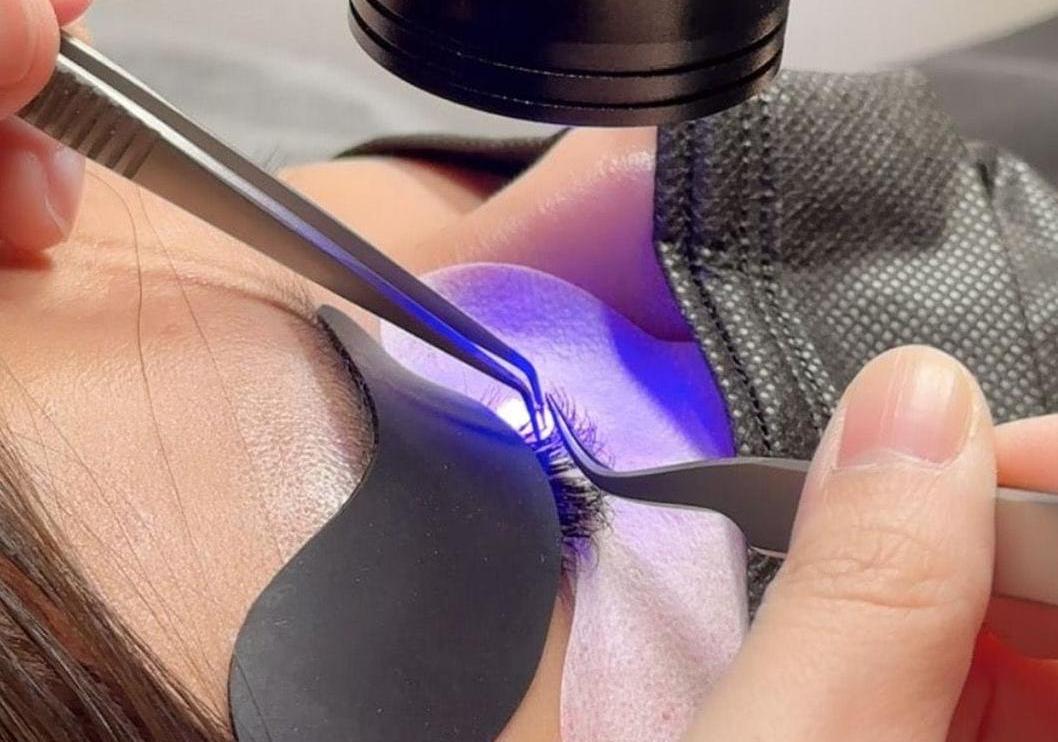
The appointment is a lot like classic, with small tweaks in technique. The artist places each lash or fan on the natural lash and immediately shines a special miniature lamp on the bonding point. The bond and cure happen faster, so there’s less chance of stickies, and the whole treatment is on average about 20% faster. Note: LED requires special equipment, so not every artist offers it yet, though more studios are adding it all the time.
How long does LED lashing really last?
Manufacturers claim 6 to 8 weeks with a fill every 3 to 4 weeks. The more honest picture: independent estimates give a real advantage over regular lashing of about 1 extra week. Wear still mostly depends on the natural lash growth cycle and aftercare. The light-cured bond is stronger than a regular one, but “twice as long” promises aren’t confirmed yet, and are most likely a marketing move.
How do you remove LED extensions?
Removal works exactly like a regular one: with remover. The bond stays cyanoacrylate, so remover softens the adhesive in a few minutes, and the artist gently takes the lashes off with tweezers. As always, leave removal to a professional rather than pulling the lashes off at home.
What about allergies and sensitive eyes?
This is where marketing often overreaches, so let’s be precise. First, separate two different things: temporary irritation (watering or redness from adhesive fumes that passes within a few hours) and a true allergy, an immune reaction that can develop in anyone, to any material, and doesn’t go away on its own.
LED genuinely helps with the first: far less uncured adhesive off-gasses, so less fume irritation. But it doesn’t remove the allergy risk. Most LED adhesives still contain cyanoacrylate, and a true allergy to it is still possible: artists report clients who reacted even to LED.
The pros and cons of LED lash extensions
Pros
- Fewer fumes: far less uncured adhesive off-gasses, so less fume irritation (but not less true-allergy risk).
- Longer-lasting result: the bond fully sets right away, so it may hold longer.
- Comfort for the artist: less dependence on humidity and temperature makes the work more stable.
- Stable in any climate: in humid or dry rooms traditional adhesives can behave unpredictably, while LED adhesive sets the same regardless of conditions.
Cons
- Cost: LED lamps and special adhesives cost more than regular materials, and the upcharge reaches the client (see below).
- Not every artist offers it: it takes separate training and equipment, so the service isn’t available everywhere yet.
- Material requirements: it needs a specific adhesive that isn’t always easy to find.
- Less independent data: most safety and wear claims come from brands, not from peer-reviewed research.
Is it worth learning LED lashing?
LED lashing suits almost every client, including those with sensitive eyes or a tendency toward fume irritation. It’s a good pick for anyone who wants a fast, comfortable treatment with a lasting result, as long as everyone is honest about what the method does and doesn’t solve. If you’re looking for a way to improve retention and make the process more comfortable, LED is worth a look.
LED lash extensions are a clear step forward: speed, fewer fumes, and a stable result in any climate make the technique appealing to artists and clients alike. The key is to approach it thoughtfully: choose a trained artist, ask about the device and adhesive, and you’ll get the most out of it.
FAQ: frequently asked questions
Is LED lashing bad for the eyes?
Done correctly, it’s considered safe: the lamp is low-powered (5 to 10W), the light reaches closed eyes for only a few seconds per lash, and there are far fewer adhesive fumes than with regular lashing. The honest caveat: there are no peer-reviewed studies on the long-term safety of LED lashes specifically, and experts differ on eye protection. Choose an experienced artist and a certified device.
What are the contraindications for LED lashing?
They’re the same as for regular lashing: an allergy to adhesive components (a patch test beforehand is recommended), eye diseases, inflammation or damaged skin, and eye-area surgery (lashing is only okay 3 months after the procedure). Read more about contraindications in this article.
LED lashing: UV or not?
Partly yes. Many “LED” lash lamps emit near-UV around 395 to 405 nm, right on the border of ultraviolet and visible light. Some manufacturers state their device emits visible violet light above 400 nm, “not UV.” It depends on the specific device, so “LED” reads as a partly softening marketing term.
How is LED lashing different from regular?
Regular adhesive cures from humidity over 24 to 48 hours; LED adhesive cures under light in seconds. From that: faster application, fewer fumes, less dependence on humidity, often slightly better wear, but more expensive and with less independent safety data.
How long do LED lash extensions last?
Manufacturers often claim 6 to 8 weeks with a fill every 3 to 4 weeks. Realistically, the advantage over regular lashing is about 1 week longer; wear still mostly depends on the natural lash growth cycle and aftercare.
What is LED adhesive made of, and does it contain cyanoacrylate?
Yes, most LED adhesives are cyanoacrylate combined with photoinitiators (a component that reacts to light).
Is LED lashing suitable for people with allergies or sensitive eyes?
It reduces fume irritation, since far less uncured adhesive off-gasses. But most LED adhesives still contain cyanoacrylate, so LED doesn’t rule out a true allergy to it.
Can you get the lashes wet right after LED lashing?
Yes. And you can after regular lashing too! Read more in our article.
How long does an LED lash appointment take?
Time-wise, LED lashing is comparable to regular. The lamp itself only runs a few minutes total per session.
How do you remove LED lashes?
The same as regular ones: with professional remover. The bond stays cyanoacrylate, so remover softens the adhesive in a few minutes, and the artist gently takes the lashes off with tweezers. Removing them yourself at home isn’t recommended.
Does LED lashing damage your natural lashes?
LED itself is no more damaging than classic: harm usually comes from improper technique, overload, or pulling the lashes off yourself, not from the curing method.
How much do LED lash extensions cost?
The price depends on the city, the studio’s level, and the volume, with a small upcharge for the LED equipment and adhesive. In the US, a classic set runs about $190, while UV/LED sets run roughly $260 to 310; the LED-specific upcharge for the equipment and adhesive is often around $20 to 25. In Australia, a classic set is about AUD $120 to 250, LED/premium sets run roughly AUD $180 to 320, and fills are about $60 to 100 every 2 to 3 weeks.
You might also like

Summer Lashing: How to Tame Your Adhesive in the Heat
How to Work With Baby Lashes (Anagen Stage)

Why You Can (and Should) Get Lash Extensions Wet
“I Swear I Washed Them!” What to Do When Clients Ignore Aftercare
The Mascara Effect in Lash Extensions
Trending Effects: Anime, Kim, Kylie, Angel
Colored and Creative Lash Extensions
Is Hypoallergenic Lash Adhesive a Marketing Myth?
Competition Lash Looks
How to Match Colored Lashes to Eye Color
Bottom Lash Extensions
The Wet Look Lash Effect
Working the Inner and Outer Corners
Adaptive Lash Extensions: What They Really Are
Lash Porosity and How It Affects Retention
The Ombre Lash Technique and Shadow Effect

Working With Lash Adhesive in Winter

Working With the L Curl
The Top 5 Trending Lash Effects (With Maps)