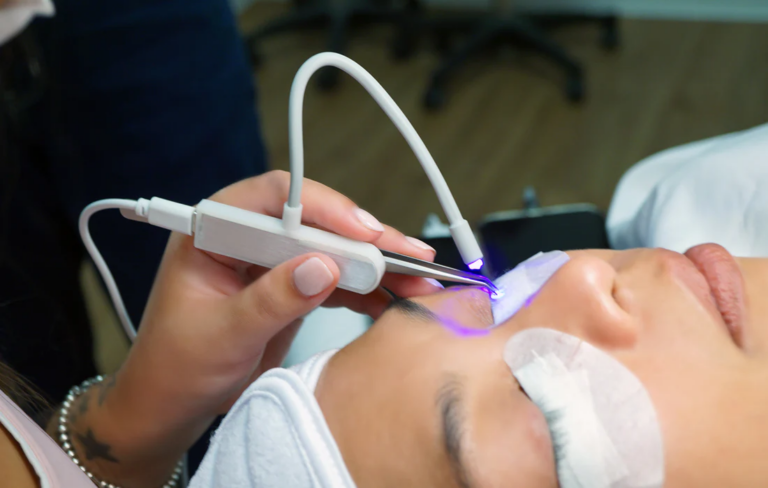
Andy Williams sings about winter in one of his most famous songs: “It’s the most wonderful time of the year!” But as many lash artists know, winter is not the most wonderful time for lash adhesive.
If you’ve ever lashed in winter, you’ve probably run into it: the adhesive gets fussy, the bond is unstable, and lashes shed faster than usual. In this article you’ll learn how to keep the cold from hurting your adhesive’s performance and your results.

The main challenges the winter season brings
1. Low humidity. Central heating dries the air out badly. Humidity can drop to 25 to 30%, which is nearly a disaster for adhesive. It starts curing slowly, the bond forms with a delay, and the extension ends up holding worse.
2. Temperature swings. If your adhesive shipped to you at 5°F (-15°C) and you opened the bottle right away, it can be ruined. A sharp swing forms condensation inside the packaging and disrupts the adhesive’s structure. Even if it looks fine, its bond can be unstable.
3. The state of clients’ skin. In winter skin is often over-dried or, conversely, extra oily, especially if a client uses heavy creams. That can affect how clean the lash surface is and, in turn, your bond.
How to adapt to winter conditions
The good news is that winter isn’t the enemy if you know how to handle it. Below is a practical guide based on artists’ experience and the chemistry of adhesive.
1. Microclimate is your main ally
Humidity. Ideal: 50 to 60%. Below that, adhesive can behave unpredictably: slow bond, a drop that “dies” fast, and unstable wear. What to do: set up a humidifier, which helps the adhesive and keeps clients comfortable. Put a hygrometer next to your work zone, not by a window or radiator. Air out the room, especially if you’re running a heater.
Temperature. Working range: 68 to 75°F (20 to 24°C). Colder and the adhesive thickens and the reaction slows. Hotter and it can cure too fast and turn brittle. If you use heaters, don’t put them too close to your station. If the heat is blasting, air the room out more often; it lowers the temperature, raises humidity, and honestly, sitting in a closed room all day isn’t great anyway, fresh air matters for feeling good.
2. How to prep adhesive for winter work
Never open adhesive right after it’s been out in the cold. Let it sit at room temperature for at least 12 hours, ideally 24. In that time it “acclimates,” and you avoid moisture forming inside the bottle.
Don’t store adhesive in the fridge. There’s no need to at any time of year, and the temperature swing is bad for it. Use a thermal container with silica gel instead, which protects the adhesive from moisture and temperature swings.
Don’t set it by a radiator or on a windowsill, and don’t expose it to sharp temperature changes.
3. How to choose the right adhesive for winter
When humidity is below normal, adhesive cures more slowly. So you want a faster adhesive to make up for that delay.
Work fast → an adhesive with a 0.5 to 1 second cure time. Work slower → an adhesive with a 1 to 2 second cure time (so it doesn’t set in the air). Don’t be afraid to test 2 to 3 adhesives. What’s perfect in summer may not work in winter. Always keep a “backup” adhesive with a different humidity range and cure time.
4. How to work your adhesive drop
Work with a dome-shaped drop and don’t “wipe” the adhesive across surfaces, which kicks off curing. Learn to pick up that one micro-drop. Take adhesive only from the center and change it on time.
Watch the texture: if the drop starts to thicken or string, change it. Don’t dispense too big a drop; in winter, smaller and more often is better.
5. A client arrives from the cold: how to prep the lashes?
Classic situation: it’s 14°F (-10°C) outside and 73°F (23°C) in your room. A client comes in from outside, her lashes cold and damp, and you absolutely should blot and dry them before applying any liquids.
Next, thorough cleansing is a must, especially if she likes heavy creams in winter. If the room is dry, definitely apply a primer or accelerator to speed up curing and improve the bond.
The takeaway
Winter demands more attention to detail. Adhesive starts behaving differently not because it’s low quality, but because the environment changed. Your job is to create conditions where it works the way it’s meant to.
If you control humidity and temperature, choose the right adhesive, prep the lashes correctly, and don’t forget to let materials acclimate after the cold, you can get beautiful wear and grateful clients in winter too.
Happy lashing!
You might also like

Trending Effects: Anime, Kim, Kylie, Angel
Bottom Lash Extensions
The Wet Look Lash Effect
Working the Inner and Outer Corners
How to Match Colored Lashes to Eye Color
“I Swear I Washed Them!” What to Do When Clients Ignore Aftercare
The Winged Eyeliner Lash Effect
How to Work With Baby Lashes (Anagen Stage)

Summer Lashing: How to Tame Your Adhesive in the Heat
Competition Lash Looks

Why You Can (and Should) Get Lash Extensions Wet
Adaptive Lash Extensions: What They Really Are
Lash Porosity and How It Affects Retention
The Top 5 Trending Lash Effects (With Maps)

Colored and Creative Lash Extensions

Working With the L Curl
The Mascara Effect in Lash Extensions
The Ombre Lash Technique and Shadow Effect
Is Hypoallergenic Lash Adhesive a Marketing Myth?